
Impeachment and Immunity
Daniel Lazare argues that the Supreme Court's decision in Trump v. United States (2024) follows the logic of an increasingly undemocratic Constitution

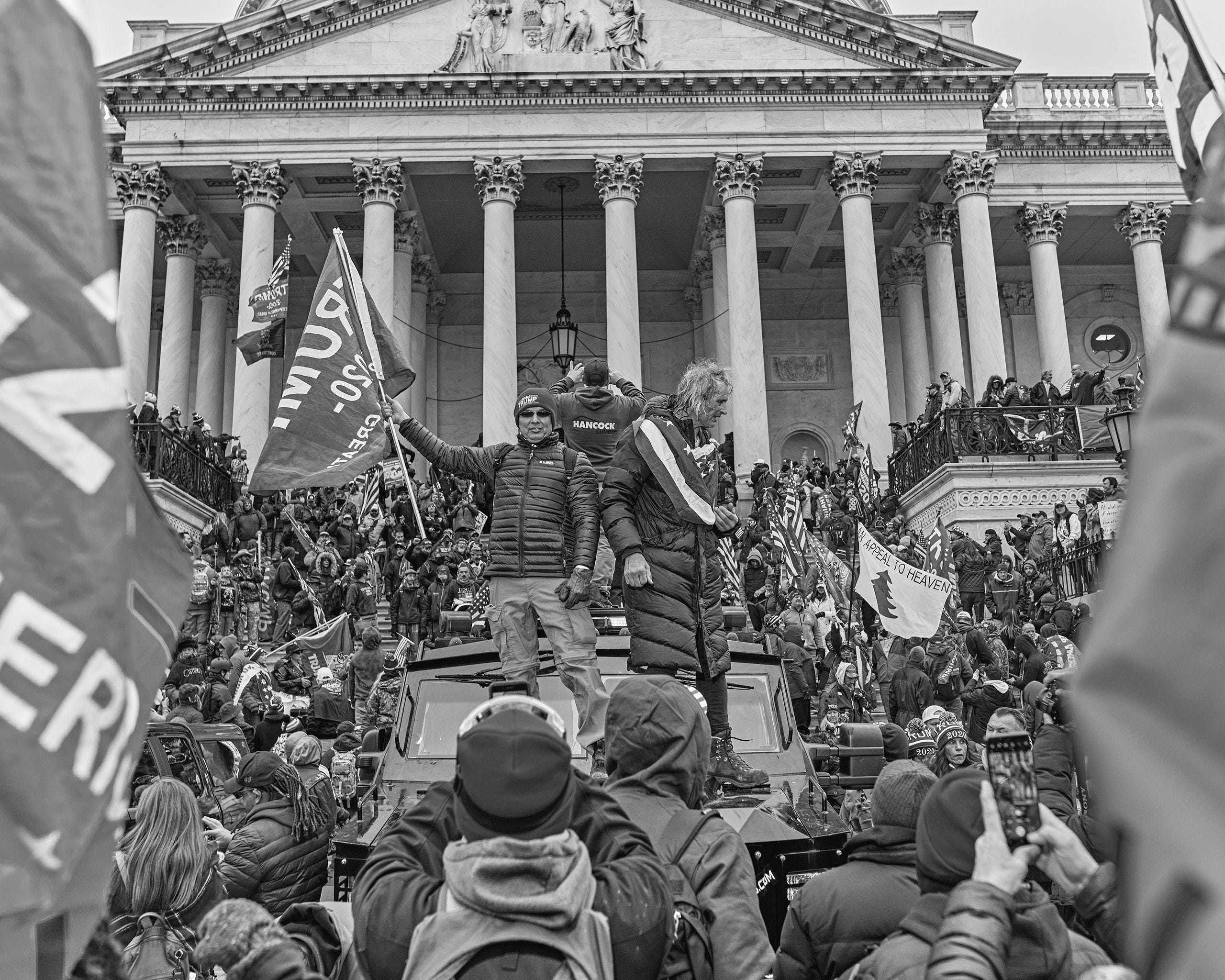
Today is the 5th anniversary of the January 6 Capitol Hill insurrection. We are republishing a 2024 article by Daniel Lazare that discusses the constitutional obstacles to holding presidents accountable, particularly the onerous impeachment clause. On July 1, 2024, the Supreme Court decided in Trump v. United States that sitting and former presidents hold broad immunity for actions taken in office.
Something is missing in the great debate over presidential immunity: impeachment. Chief Justice John Roberts mentioned it only once in his majority opinion, which is when he dismissed Donald Trump’s double-jeopardy argument that his Senate acquittal for crimes related to the January 6 coup attempt means that he can’t be tried a second time in a lower court. But that was it. Sonia Sotomayor didn’t mention it in her dissent, and neither did Ketanji Jackson.
All of which is strange for two reasons. One is that impeachment is supposedly the first line of defense against a runaway presidency, which is what Trump v. U.S., as the case is formally known, is all about. So shouldn’t someone at least acknowledge that the mechanism has failed?
The other is that if the Senate had voted to convict Trump, the immunity issue would never have arisen in the first place. Unlike the rest of the Constitution, Article II, Section Three, is crystal clear. “Judgment in Cases of Impeachment,” it says, “shall not extend further than to removal from Office, and disqualification to hold and enjoy any Office of honor, Trust or Profit under the United States: but the Party convicted shall nevertheless be liable and subject to Indictment, Trial, Judgment and Punishment, according to Law.”
That means that while the Senate can’t send anyone to jail on its own, it can open the door to prosecution by voting to convict. So if a two-thirds majority had said yes back in 2021, then federal prosecutors would have been free to throw the book at Trump without having to worry about the consequences in terms of presidential power and independence. The system would have worked, the conspirator-in-chief would have been made answerable for his crimes, and, if convicted, he would presumably have gone to prison for a long, long time. All would be equal before the law. It’s only because the mechanism failed that the Court is now tying itself up in knots over the question of when a president is criminally liable and when he isn’t.
So why did the clause fail? And why isn’t anyone talking about it afterward?
The second question is easy. The Supreme Court is a creation of the Constitution. (See Article III for further details.) Since it exists under it, its job is to interpret rather than question or criticize. Its duty is to hold its tongue even in the face of obvious structural shortcomings. The same goes for elected officials. Since every last one of them is “bound by Oath or Affirmation, to support this Constitution,” to quote Article VI, they are also constitutionally barred from questioning it in any fundamental way.
It’s like some broken-down rattletrap that can barely make it out of the garage. As long as everyone vows that the family car must be “more perfect” with each passing year, then no one is allowed to say a word when the wheels fall off or the brakes cease to function. They’re not even allowed to notice. All they can do is thank the founders for providing them with such a wonderful vehicle in the first place.
The answer to the second—why the impeachment clause flunked the test after the Capitol Hill insurrection—requires a bit more thought. Obviously, the two-thirds hurdle is too high. Given that the Senate is organized on the basis of equal state representation, it means that 34 senators from 17 states representing less than eight percent of the population are enough to acquit. 92 percent of Americans may agree that Donald Trump is a threat. But the Constitution condemns them to inactivity as long as one person in 13 refuses to go along.
The solution therefore seems clear: lower the barrier. After all, two-thirds is a figure that the founders plucked out of thin air. So why not make it three-fifths, four-sevenths, or a simple majority? That should be enough to stop presidential wrongdoing in its tracks. But there’s a problem, and it isn’t just an amending clause that allows an even smaller minority—4.4 percent according to the latest census data—to veto any and all efforts at reform. Rather, the structure, in general, is so tightly constructed and so well-integrated as to effectively rule out a structural change of nearly any sort.
After all, a two-thirds barrier means that the chief executive can do just about anything he wants short of assassinating the speaker of the House in the middle of a congressional session. Since conviction is close to impossible, presidential independence vis-à-vis the other two branches is assured. But if we lower the barrier to three-fifths, he becomes less independent and more easily threatened. The separation of powers is reduced. If we lower it to four-sevenths, the effect is even more pronounced. And if we lower it to a simple majority, then the governing structure begins to resemble a parliamentary democracy in which the legislature calls the shots and the president is reduced to little more than a figurehead.
This is profoundly un-American since the revolution that created the U.S. nation-state was a rebellion against parliamentary government. The king had grown too weak according to a school of thought known variously as 18th-century “republicanism” or the “Country opposition,” while the House of Commons had grown too strong. Balance should be restored. A dozen years after Bunker Hill, the founders, therefore, set about building an elaborate contraption filled with all sorts of counterbalances and offsetting mechanisms so as to create an executive branch that was strong but not too strong and a legislature that was incapable of ruling on its own. The upshot centuries later is a democracy that is lost in the wilderness as the government grows more and more counter-majoritarian. No one can change a thing for fear that the entire apparatus will collapse in a heap.
Given all that, Robert’s opinion makes “sense” in that it is essentially in keeping with a larger structure that grows more undemocratic by the day. Since the independence of the executive branch must be preserved, interference by the judicial branch must be constrained. Even if the president orders the Air Force to bomb and strafe Capitol Hill, the courts won’t be able to do a thing unless the Senate follows proper constitutional procedure by holding an impeachment trial and voting to convict. If that is what “the supreme law of the land” says, then that is what we must do.
This is why people go to law school—so they can utter such inanities with a straight face. The Sotomayor-Jackson opinions, meanwhile, make no sense whatever because they try to turn the Constitution into something it is not, i.e., an instrument of democracy.
“[T]he president ... represent[s] all the voters in the Nation,” Sotomayor’s dissent says at one point, quoting a 1983 case called Anderson v. Celebrezze; “...his powers are given by the people under our Constitution.” The statement is breathtaking considering that two of the last four presidents took office against the people’s express will. Says Jackson: “If the structural consequences of today’s paradigm shift mark a step in the wrong direction, then the practical consequences are a five-alarm fire that threatens to consume democratic self-governance.”
But what democratic self-governance is she talking about? She continues:
“The Court has now declared for the first time in history that the most powerful official in the United States can (under circumstances yet to be fully determined) become a law unto himself. As we enter this uncharted territory, the people, in their wisdom, will need to remain ever attentive, consistently fulfilling their established role in our constitutional democracy, and thus collectively serving as the ultimate safeguard against any chaos spawned by this Court’s decision. For, like our democracy, our Constitution is ‘the creature of their will.’”
But how can the people serve as “the ultimate safeguard” when the Constitution has reduced their power to the vanishing point? How can the Constitution be “the creature of their will”—Jackson is quoting a famous 1821 case called Cohens v. Virginia—when they have never had a chance to vote yea or nay on it as a whole?
It’s worth noting at this point that Forrest McDonald, a well-known historian of impeccably conservative credentials, calculated in 1965 that just 160,000 voters, barely four percent of the U.S. population at that point, took part in state ratification elections in 1787-88. Since every last one of them was a property-owning white male as far as anyone can determine, the vote hardly qualifies as democratic by modern standards. The bottom line is that the Constitution has never been democratically approved before or since. It is not the creature of anyone’s will other than that of a tiny 18th-century elite. On the contrary, it is a big fat fait accompli that no one knows what to do about, even though it is squeezing the lifeblood out of society.
Sotomayor’s rhetoric is stirring. Now that the Court says the executive is immune from prosecution, she notes that the president can do just about anything he wants without having to worry about the legal consequences. “Orders the Navy’s Seal Team 6 to assassinate a political rival?” she asks. “Immune. Organizes a military coup to hold onto power? Immune. Takes a bribe in exchange for a pardon? Immune. Immune, immune, immune.”
“With fear for our democracy, I dissent,” she concludes. But fear is beside the point at this late date since democracy has been in the grave for a generation. All the immunities decision does is shovel a bit more dirt onto the coffin.
Hi Daniel, thanks for usefully pointing out that the only real element of the 1787 Constitution that prevents a President from going full Bonaparte is Senate conviction. I was surprised to read though that the American rebellion was also influenced by "a school of thought known variously as 18th-century “republicanism” or the “Country opposition", to the extent that it was transmitted into the counterrevolutionary Convention in the form of a strong Presidency created to overbalance the Legislative branch.
The "Country Party" was a Jacobite monarchist political trend that took up the populist rhetoric of the classical commonwealthmen of the 16th century English Revolution under the influence of Henry Bolingbroke https://en.wikipedia.org/wiki/Henry_St_John,_1st_Viscount_Bolingbroke
One could say this was the original "horseshoe" reactionary populism for which MAGA is the current representation. However I tend to follow J.G.A. Pocock in his assertion that it was the commonwealthmen tradition that originated with James Harrington and his political utopia, The Commonwealth of Oceana, that was the main influence with the American rebels, both ruling class and plebians.
That doesn't mean that the rebels weren't influenced by other currents of thought. It does mean that we should be careful not to confound the Harrington commonwealthmen, whose "ancient constitution" was imagined to be that of the old Anglo-Saxons, with that of the Bolingbrokes whose old constitution was that of high Medieval feudal monarchy.
The rebels were also not opposed to parliamentarianism in principle. They had their colonial assemblies, and they made some formally more democratic in structure, though property qualifications on an electorate limited to white men remained in place. It is likely that the participants in the 1787 constitutional coup leaned more toward a Lord Protector or, in the case of Madison, two Lord Protectors, the other being a Supreme Tribunal. But these were also primarily republican, it was only that their republican vision was that of Machiavelli's ancient Roman Republic "for expansion" and of the medieval Venetian Republic, for oligarchy - not monarchy. In other words, Harrington, but with his landed gentry replaced with "antediluvian" merchants.
Nevertheless I'd be interested in any historical references to Bolingbroke "country party" influences on the American revolution. For more see my https://chicxulub.substack.com/p/the-painted-face-of-us-politics